Thursday, February 16, 2017

Random Acts of Kindness

Valentine's Day Pictures 


Random Acts of Kindness Assembly

This class was really good at being NICE! Each class was assigned a Random Act of Kindness. Our class built a bird feeder for the courtyard at Wheelock School. 


We also learned a song to sing in front of the REST of the SCHOOL about being the best you you can be!

 What's In Me video


Random Acts of Kindness Week! 

Vacation is Starting!


Hooray! 


Don't forget to R-E-A-D! 


Book suggestions....
  • any Humphrey book (but in order is best)
  • Yang series 
  • Nicholas series
  • Fractions = Trouble (Mills)
  • Sam series  (try Attaboy Sam) - Lowry
  • The Mouse and the Motorcycle
  • Ramona Quimby
  • Sideways School series (Sachar)
  • Oggie Cooder (Hess)
  • Judy Moody and Stink
  • a mystery (A to Z or Calendar Mysteries)
  • Class Clown (Hurwitz)
  • Herbie Jones (Kline)
  • Charlie and the Chocolate Factory
Or you can check out this link to GOOD READS which is where I get a LOT of the book ideas! (click on link!) 


Finally, after VACATION we will be doing our annual 
Pennies for Patients fundraiser! Get ready! Lift the cushions, look under the seats in the car... find your spare change! 


Thursday, February 2, 2017

It's February!


Today was Groundhog Day. Apparently our furry friend did indeed see his shadow, so we will have 6 more weeks of winter. 


We have been working on a lot of non-fiction reading and writing. Students are working on their informational texts. We are trying to incorporate some non-fiction text features into our work.  We may need some help from home to print out pictures, charts, or diagrams for our final drafts. Stay tuned! 

We have been reading about ants. Did you know that there are 10,000 kinds of ants?  A person who studies ants is called a myrmecologist. Ants have the most advanced brain of ALL insects. 


In math, we finished up our unit on graphing and have started a unit on addition and subtraction. We are working A LOT with mental math strategies.  We have been beginning our math lessons with NUMBER TALKS. 

These get us to think flexibly about how to solve problems. We take all answers and then DEFEND the answer that we chose. Students are learning that there are many different ways to solve problems in their head! 


We have also been working on ROUNDING to the nearest 10 and 100. This handy little rhyme helps us. Ask your child to explain it to you. 

 
Did you check us out on Twitter rounding numbers that are in the millions?  We are THAT SMART here in Room 102!  


Today, I shared Greg Tang's website with the class and it was a HUGE HIT!  Students can log on at home @ www.gregtang.com
Then click on games!  I highlighted and shared some fun ones in class today and the excitement was electric! This is an EASY way to get your child to practice his/her addition and subtractions facts or multiplication and division facts!  They love the challenge! 

Be careful Mom and Dad, you might get hooked too! 

Sir Isaac Newton was born in 1642.  He was an English scientist who changed the way people think about the motion of objects. His work influenced later scientists such as Albert Einstein. We learned about gravity and friction and NOW we are doing experiments to learn about Newton's 3 Laws of Motion. 


We learned that an object at rest will remain at rest and an object in motion will remain in motion UNLESS acted on by a force. That was Newton's first law. 

Then we did an experiment trying to move a ping pong ball and a golf ball across the surface of a table using a force (blowing through a straw). We FOUND that it requires more force to move an object with more mass!  And we saw that the object will move in the direction of the force!  That is Newton's second law! 

So, the second experiment is a little gross. Did you know that when 3rd graders blow with excessive force through a straw there tends to be an abundance of SPIT?  Yes, it is true! Caroline C. told me she was light headed from the "force" used!  


The purple table is working hard! 

And FYI, we washed the tables MORE THAN ONCE!  I also washed the ping pong and golf balls as well.  The ICK AWARD was definitely won by the RED TABLE!  


Okay... I am going to head home now!  Remember to ask your third grader OPEN ENDED questions about school... not, "How was your day?"  As you can see... we certainly do a lot each day!  

Monday, January 23, 2017

Today is Day 90!

Today is DAY 90! 
You know what that means! We are one half of the way through our third grade year! 


We have been busy these past few weeks.  We enjoyed having a student teacher. Miss Lacroix enjoyed her time in third grade. 
We have been reading a variety of non-fiction texts. We started with Deadliest Animals. On the cover is a fierce lion and the first page shows us his sharp teeth and claws.
He does look deadly!
Wow... those teeth! 


We were impressed and thought it indeed looked deadly. BUT... do you know what animal is the deadliest of them all?  

Yup... here it is. The DEADLY mosquito. 


That's right. The mosquito is the deadliest animal. Each year, 2 to 3 million people die from diseases transmitted by mosquitoes. Then we had a conversation about why the lion was on the cover. How SCARED would you be looking at the mosquito?  

Our non-fiction journey continued with Dolphins. With this book, we really looked at the non-fiction text features that were included in the text. There was:
What did you see?

  • an index
  • charts
  • a glossary
  • bold print
  • colored text
  • diagrams
  • pictures
  • captions
  • text boxes


Finally, we read Titanic. We started off by sharing our schema (prior knowledge/what we already know). Then we predicted what we might find out or learn. We asked questions and then began to read! 
In 1912, Titanic was the biggest ship ever built.
It was called a "floating palace". 

 The students LOVED this book.

Did you know...

  • the ship had four elevators, a heated swimming pool, a gym, 2 barber shops, and two libraries?
  • some passengers paid about $99,000 of today's money to travel aboard Titanic?
  • Titanic was as long as three football fields?
  • more than 1,500 passengers and crew died?
We are now starting to read books in small groups and using the same format of tracking our learning. 
Using the FAB FOUR to help us learn! 

Working on reading non-fiction is going along hand in hand with writing non-fiction. Students have started their informational writing in class. We started with our expert lists and then we brainstormed what we could say about our topics. We visited the library to search for resources to help us. We then wrote introductions about our topic.


We reviewed an example to get ideas of how to write our introductions. We also looked at 23 other non-fiction books
 (1 per student) to see how each book started! 

Students are now working on the chapters of their texts. Thank you for helping out with research at home. Having extra information on hand helps our writers KEEP on writing!


We are circling back to what we have seen the EXPERTS do and trying to add some of the text features we have seen into our own work!
Chapter work... with text features!

SCIENCE

So we are learning about forces and motion. We did some experiments with friction and some with gravity. Parachute Guy was fun! We learned about how things fall. Two pieces of paper fall differently depending of the shape of the paper. We learned about AIR FRICTION. We did several trial runs of Parachute Guy's descent. I'm sure some trials continued at home from various heights as well.
From the second floor or Wheelock School, Parachute Guy attempts his most daring jump yet... 

We are now reading and learning about Sir Isaac Newton, the famous English scientist who is said to have "discovered" gravity.

We read about Sir Isaac Newton and highlighted what we thought we important details from the text. We charted those details on the board. BUT THEN, we went further and divided the details into to categories.. INTERESTING or IMPORTANT. We used our knowledge from Titanic to help us. Titanic had 2 barber shops! Interesting or important?  Titanic did not have enough lifeboats for all the passengers since the builders wanted to allow space for first class passengers to stroll on the deck. Interesting or important?  They could easily tell these apart. What about Sir Isaac Newton. He never married. Is that interesting or important?  He developed a form of math called calculus. Interesting or important? We decided what we thought!

We will now start to learn about Sir Isaac Newton's three Laws of Motion. Stay tuned!

MATH 

From area to graphing! We are working on reading, understanding, and making bar graphs and picture graphs. We spent time today talking about the difference between reading a graph and interpreting a graph. Take a look!
Reading a graph:
"Basketballs and jump rope have the same number."
Interpreting a graph:
"There are three times as many soccer balls as bats."
 

Interpreting a graph involves more thinking! And that is what we want our students to do!

We are also creating our own graphs.


For this journal problem, students had to use the given data to create a bar graph. The question asks them to graph the coins two brothers have in their piggy banks. They must include a title, a label for both the x and y axis, and a scale greater than one. And just when they thought they were done, I asked them to SOLVE and find out how much money the boys had!

And that's not all... we have also been learning about prefixes and suffixes, new words, elapsed time, main idea, author's purpose, cursive letters, possessive nouns....

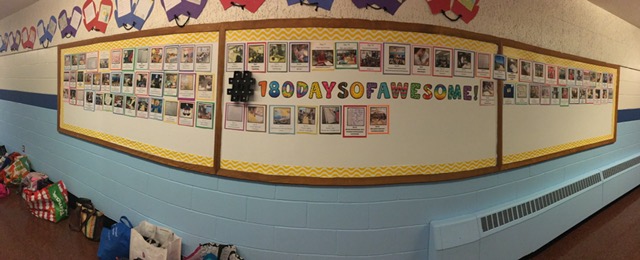
Check back later... or be sure to follow us on TWITTER! #180daysofawesome


Thursday, January 5, 2017

Happy New Year!

Happy New Year to everyone!

Room 102 is starting the year off with lots of learning!  We came back on Tuesday and got right back to work.  We wrote New Year's resolutions. What will it mean for 2017?  Ask your child about his/her promises for the new year? 
Catherine and Jaxon work on their lists. 


Caroline writes her resolutions. 


We also started a new book called Donavan's Word Jar. Donavan is a third grade boy, who like his classmates, likes to collects things. But his collections is a little different. He collects words! Yes, words.  
Donavan Allen collects words. 
We will be spending the next few weeks learning about Donavan's collections and starting a word collection of our own. Do you have any words that you like?  Your 3rd grader will be asking you to share. So, be ready! 


Here are some of our classmates discussing the book. 


We have started a CLASS WORD JAR as well as individual word jars as well. 


AREA! 

We have been working on the areas of polygons for a few weeks. We made our own sports complexes. And, more recently, designed our own robots to work on the area of regular and irregular shapes. We have been working in math stations to practice math fluency, meeting in small groups to review concepts, and working individually or with a partner to answer questions. 
Math Journal Question - find the area! 

Using geoboards to make shapes with an area of 4 square units! 

Check our our area robots! 

More AREA-BOTS!